There is an easy way to make a heritage collection. Save a reference, lift the motif, flatten it, print it. The result looks Indian from across the room and says very little up close.
DORI, a design-led jewellery house founded by siblings Simran and Sidharth Gulati, says it took the slow route with Bandhani, and that the slow route was the only one worth taking.
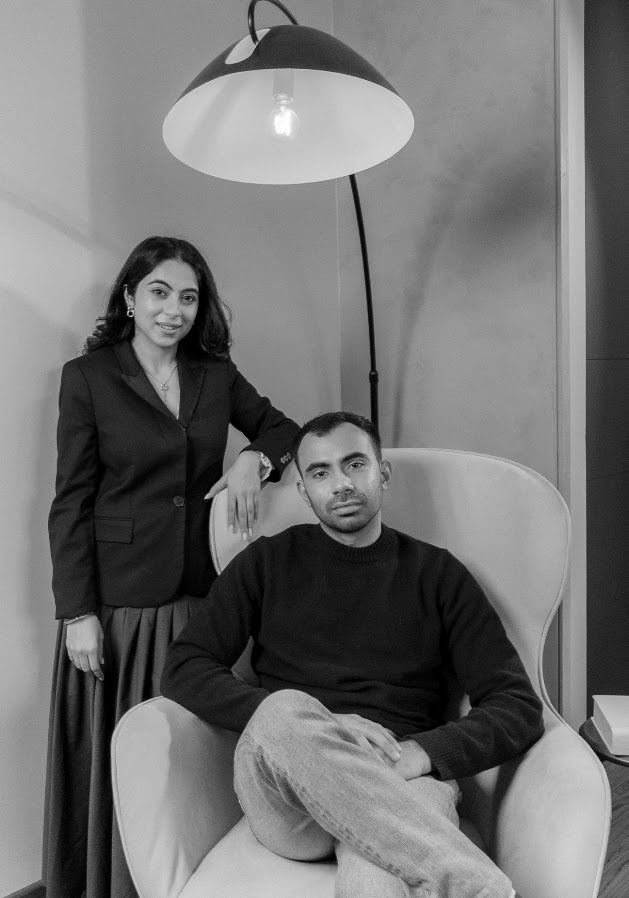
“It was never about making a literal replica of a Bandhani dot,” Simran Gulati, DORI’s co-founder, said in a statement. “A reference can be copied. A craft has to be understood, and honestly, that was not easy.”
The dot
Bandhani is tie-dye in the oldest and most disciplined sense. The name comes from the Sanskrit root bandh, meaning to bind or tie. Cloth is plucked into thousands of tiny bindings, then dyed, so that each tied point resists the colour and opens into an undyed dot. Untie the thread and the pattern appears.

The craft is commonly described as about 5,000 years old, though that figure is a widely repeated estimate rather than a precisely dated fact. The documentary trail is firmer in later periods. The earliest well-known depiction of Bandhani dots appears in 6th-century paintings in Cave 1 at Ajanta, and textual tradition places a Bandhani saree at a royal wedding in Banabhatta’s Harshacharita. The craft has been part of weddings, rituals and everyday dress for a very long time.
The knot nobody can repeat
DORI’s starting point was not the finished pattern but the process behind it. Before working in metal, the Gulatis say, they went back to the raw materials: cloth, thread, the pinch of the tie, the negative space at the centre of each dot.
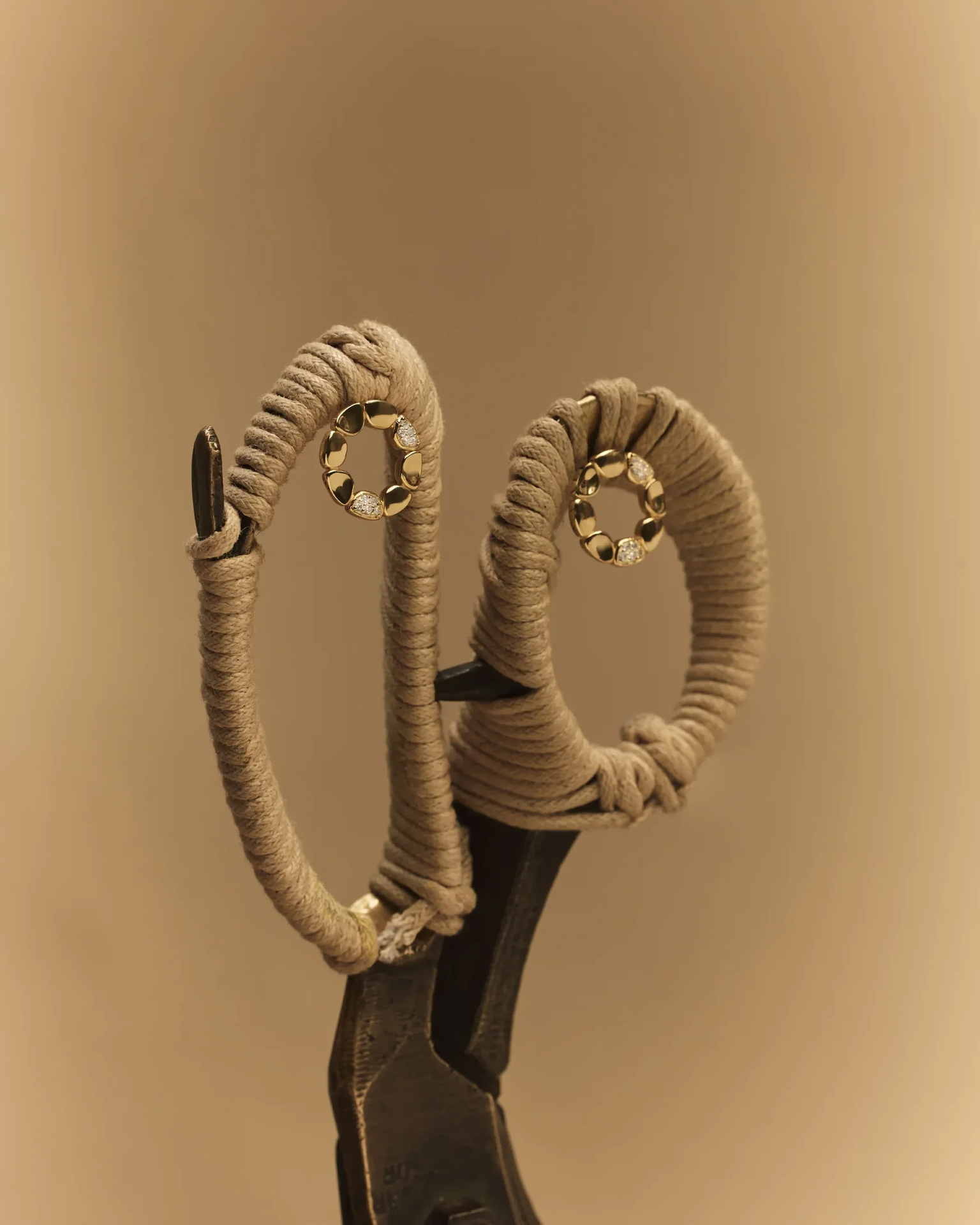
What they found shaped the collection. Every knot is tied by hand, under slightly different pressure, so no two dots come out identical.
“Every tiny variation isn’t a flaw,” Gulati said. “It’s a reminder that beauty comes from individuality. Each knot is like one of us, formed from the same cloth, shaped under pressure, completely unique. That raised knot is the real soul of Bandhani. Understanding it was the only way we earned the right to translate it.”
The point is simple and a little uncomfortable for anyone who has made a motif-driven collection. A printed dot is uniform. A Bandhani dot is not, and that irregularity is the craft, not an error in it.
Shadow out of metal
So DORI did not reproduce the dot. It reproduced what the dot leaves behind.
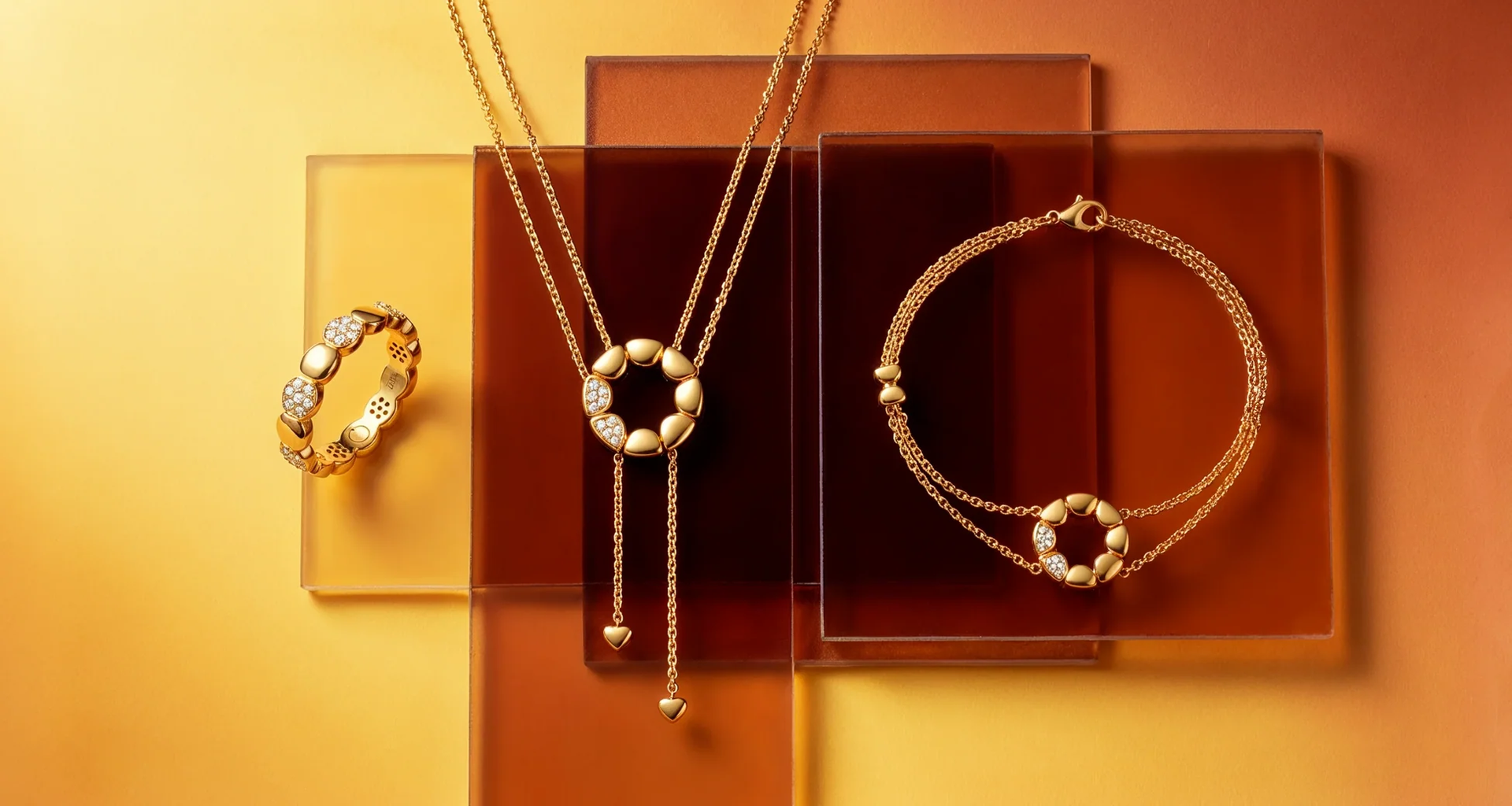
The brand studied the three-dimensional impression a tied knot leaves in cloth once it is opened, then sculpted that texture into metal: concave and convex surfaces, an open centre, and a raised back gallery engineered behind each pendant. The gallery lifts the motif off the skin, so the piece reads with depth rather than lying flat.
The pieces are made in 925 sterling silver with 18kt gold vermeil and hand-set cubic zirconia. The point of the construction, the brand says, is weight: festive presence in something light enough to forget you’re wearing.
What 'vermeil' actually means
Vermeil is a regulated word, and it matters here because DORI makes durability a selling point. Under US Federal Trade Commission standards, a piece can only be called vermeil if it has a sterling silver base and at least 2.5 microns of gold at 10 karats or higher. Standard gold plating is typically far thinner, around half a micron.
DORI says each piece layers 2.5 microns of 18kt gold over sterling silver, which sits at the legal minimum for thickness and above it for purity. The brand says it is held to the FTC vermeil standard and that the pieces are designed to last for years. The first part is checkable against the standard. The second is a brand claim, and years of daily wear is the only test that settles it.
Design from memory
Ask Gulati where a DORI piece begins and the answer is not a trend report. “It began with an image almost every Indian carries,” she said of the collection. “A sunset over the white sand of Kutch, camels, women walking in colour. That’s where we started.”
Memory is the method. The brand pulls from what India already holds collectively: textiles, rituals, art, a grandmother’s wardrobe. Bandhani fits because it is both sentimental and structural. It shows up in dupattas, wedding safas, baby-shower rituals and everyday saris, and it is also, as Gulati put it, “so deeply Indian, yet so graphic, tactile, and alive.”
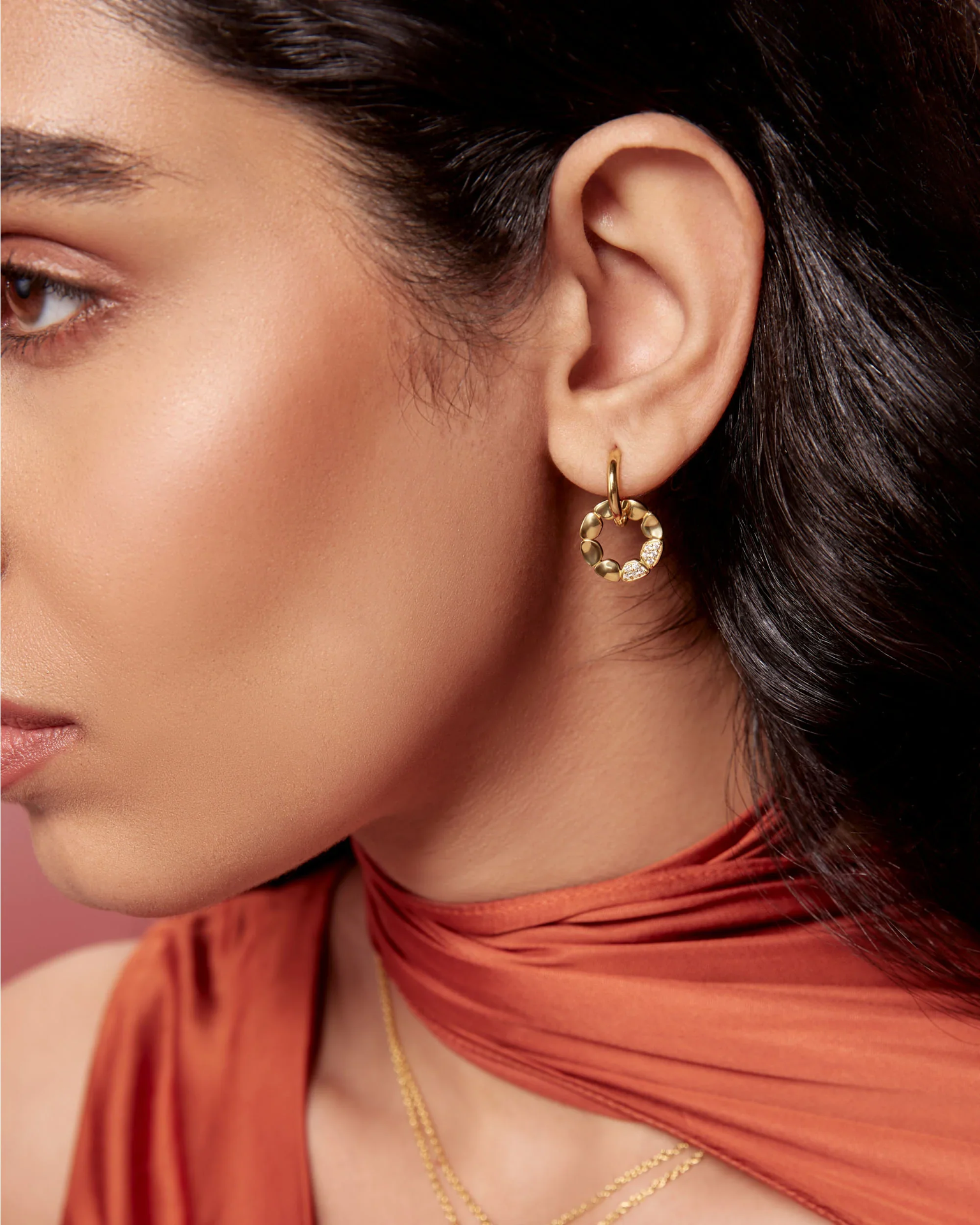
That graphic quality is where the geometry takes on meaning. DORI assigns symbolism to the forms: the knot for beginnings, the open centre for protection, the circle for continuity. “When you wear it, I hope you feel connected to craft, to memory, to India, and to yourself,” Gulati said. “Not in a dusty way. In a way that feels personal.”
The argument under the collection
The Bandhani collection is also a position, and the Gulatis state it plainly: Indian design keeps looking outward.
“For years, Indian brands have reached for international references and moods, and produced work that looks like everyone else’s,” Gulati said. “But we sit on one of the richest archives of stories in the world: our textiles, our monuments, our folklore, our craft. Indian design hasn’t been defined yet, not for lack of material, but because we keep looking outward.”
Her brother and co-founder Sidharth, who leads product design, takes it a step further. “An Indian story shouldn’t sit on one cloth in one region,” he said. “It should be everywhere, redrawn, reimagined, recontextualised, until it stops being filed under ‘heritage’ and becomes, simply, design.”
The siblings’ résumés explain some of that confidence. Both studied at The Hong Kong Polytechnic University. Simran built her career across global consumer brands including Casetify and Esprit, with collaborations involving Disney, Marvel and Lane Crawford. Sidharth worked as an Innovation Designer at Accenture and has designed for brands including Chanel, Marriott and MetLife. DORI is their attempt to point that international training at an Indian archive.
Not a festival piece
The collection is built for Diwali, but the Gulatis say that is where it starts, not where it ends. Festive jewellery has a familiar life cycle: worn for a night, then locked away.
“The only brief I give my team is that Indian design should never be trapped in occasion wear,” Gulati said. “Wear it with a heavy drape on Diwali night, and throw it on with a crisp linen shirt on Monday morning. It should work with both.”
Sidharth Gulati describes the brand’s wider approach to the craft in similar terms: “We aren’t preserving craft like a museum piece, and we aren’t copying it either. We’re translating it, into something light enough to belong completely to your present and every day of your life.”
What remains to be proven
This is a young brand. DORI launched in 2025, and the collection’s central claims, that the translation is faithful, that the pieces are comfortable enough for daily wear, that the finish holds, are ones the market will test over time. The brand also frames its approach as honouring the artisan “in the frame and not just on the invoice.” Who the artisans are and how they are involved is a question the collection’s pitch raises but does not yet answer.
What the collection does offer is a clear idea, executed with some rigour: that respecting a craft means doing the groundwork first, and that the most interesting source material for new Indian design may be the archive already in front of it.
The Bandhani collection starts at INR 7,499 and is sold exclusively through the brand’s website, my-dori.com.